> For the complete documentation index, see [llms.txt](https://docs.imerit-prod.io/llms.txt). Markdown versions of documentation pages are available by appending `.md` to page URLs; this page is available as [Markdown](https://docs.imerit-prod.io/project-setup/create-recipe/1.-basic-details.md).
# 1. Basic Details
Fill in the basic details about the labeling project:
1. [Annotation Tool](#annotation-tool)
2. [Name and Description](#name-and-description)
3. [Sequential Task](#sequential-task)
4. [Reference Images](#reference-images)
5. [Overlapping of Annotations](#overlapping-of-annotations)
6. [Tracking in Multi-Sensor](#tracking-in-multi-sensor)
## **Annotation Tool**
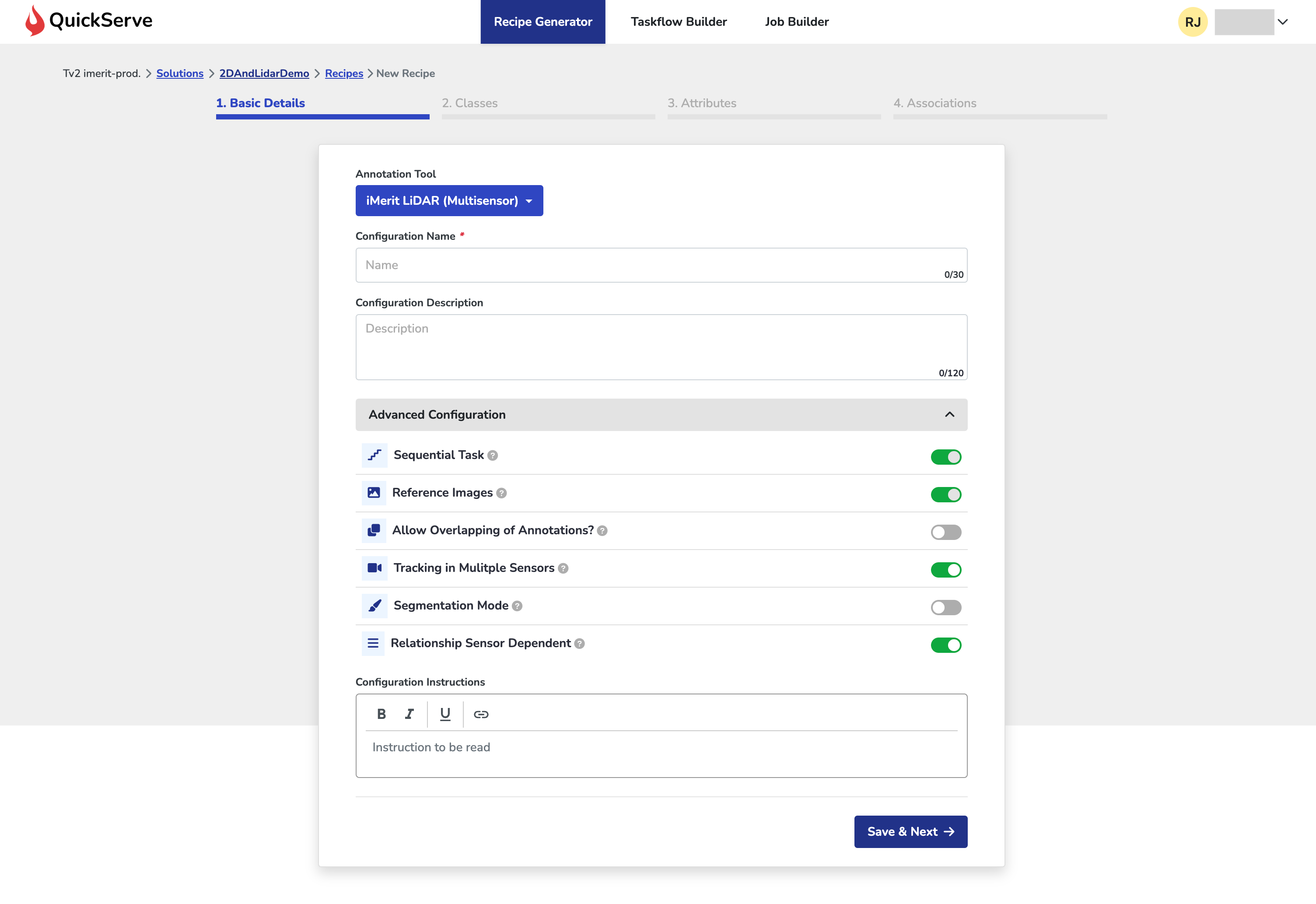
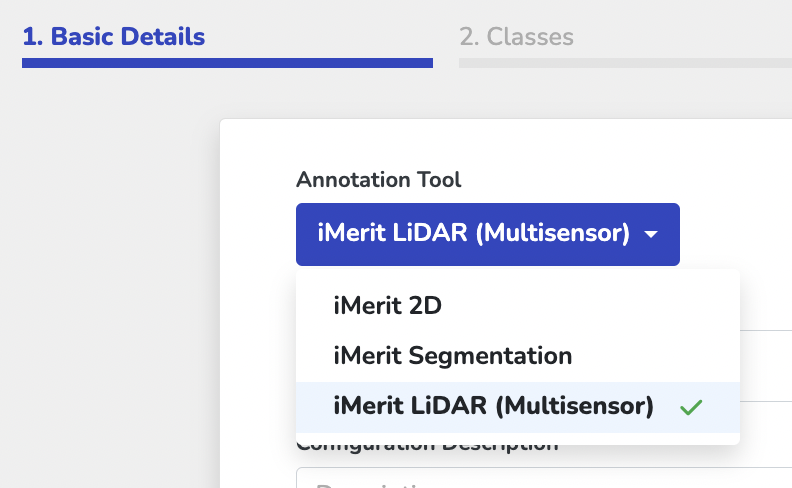
Select the Annotation Tool based on the type of labeling requirement. The default [annotation tool ](/annotation-tool.md)selected is ‘iMerit LiDAR (Multisensor)’
## **Name and Description**
Give the recipe a name and description for contributors to understand.
## Sequential Task
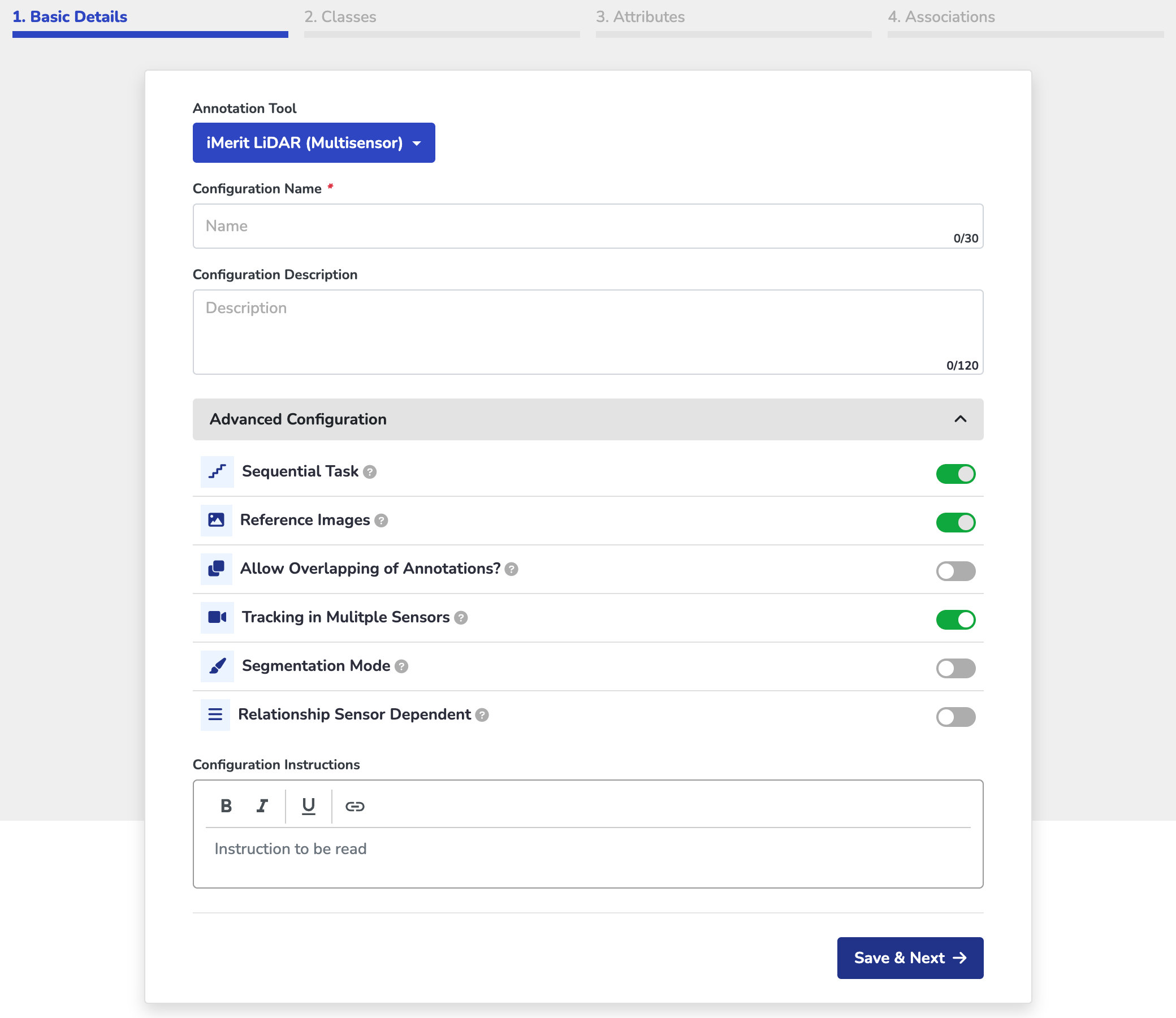
Toggle this option ON if the uploaded [frames](/project-setup/pre-process-data.md#frame) belong to a single [batch](/project-setup/pre-process-data.md#batch). Enabling this will activate the [keyframe interpolation](/annotation-tool/key-features/keyframe-interpolation.md) feature in the tool, allowing seamless interpolation across [frames](/project-setup/pre-process-data.md#frame). Leaving this toggle button ON for single-frame [batches](/project-setup/pre-process-data.md#batch) has no adverse effect on the annotator's experience.
{% hint style="success" %} Assign all [frames](/project-setup/pre-process-data.md#frame) of a sequence to a single annotator. This ensures they have object context from adjacent [frames](/project-setup/pre-process-data.md#frame), aiding in identifying objects that may be unclear in the current [frame](/project-setup/pre-process-data.md#frame).
{% endhint %}
## Reference Images
Toggle this option ON if the task requires referencing camera images for object identification or labeling. Enabling this will display an [image panel](https://docs.imerit-prod.io/project-setup/create-recipe/pages/t1P8d2reKe3nZWAkN2Kh#id-5.-image-panel) within the [annotation tool](/annotation-tool.md) for easy reference.
{% hint style="warning" %}
Calibration files of images will be needed at the time of [data import](/project-setup/build-jobs/2.-data-import.md). Learn how to prepare the [calibration file](/project-setup/pre-process-data.md#step-3-create-calibration-folder).
{% endhint %}
## Overlapping of Annotations
Toggle this option ON to allow two annotations to overlap without conflict detection. Turning it OFF will enable the tool to identify overlapping annotations and display a conflict alert. When a conflict is detected, the user will have the option to override the first classification at the overlapping instance.
## Tracking in Multi-Sensor
Enable this option to track an object across multiple sensors within a [frame](/project-setup/pre-process-data.md#frame) or across [frames](/project-setup/pre-process-data.md#frame) in a [batch](/project-setup/pre-process-data.md#batch). When toggled ON, the tool will assign a unique ID to the object, allowing the identifier to be shared across visible sensors seamlessly.
## Segmentation Mode
Toggle this option ON to enable the segmentation tool. This will disable the geometry tool and allow annotators to segment points within the point cloud and pixels in the camera sensor images.
## Relationship Sensor Dependent
* Toggle this option ON to allow relationships to be defined independently within each sensor view. This means the same objects can have different relationships (or none at all) depending on the sensor perspective, giving you more granular control in multi-sensor scenarios. Toggle it OFF to create frame-level relationships that automatically apply across all sensor views.
* By default, the tool supports the toggle ON option.
[Learn how to use](/annotation-tool/key-features/relationship-sensor-independent.md)
 Assign all [frames](/project-setup/pre-process-data.md#frame) of a sequence to a single annotator. This ensures they have object context from adjacent [frames](/project-setup/pre-process-data.md#frame), aiding in identifying objects that may be unclear in the current [frame](/project-setup/pre-process-data.md#frame).
{% endhint %}
## Reference Images
Toggle this option ON if the task requires referencing camera images for object identification or labeling. Enabling this will display an [image panel](https://docs.imerit-prod.io/project-setup/create-recipe/pages/t1P8d2reKe3nZWAkN2Kh#id-5.-image-panel) within the [annotation tool](/annotation-tool.md) for easy reference.
{% hint style="warning" %}
Calibration files of images will be needed at the time of [data import](/project-setup/build-jobs/2.-data-import.md). Learn how to prepare the [calibration file](/project-setup/pre-process-data.md#step-3-create-calibration-folder).
{% endhint %}
## Overlapping of Annotations
Toggle this option ON to allow two annotations to overlap without conflict detection. Turning it OFF will enable the tool to identify overlapping annotations and display a conflict alert. When a conflict is detected, the user will have the option to override the first classification at the overlapping instance.
## Tracking in Multi-Sensor
Enable this option to track an object across multiple sensors within a [frame](/project-setup/pre-process-data.md#frame) or across [frames](/project-setup/pre-process-data.md#frame) in a [batch](/project-setup/pre-process-data.md#batch). When toggled ON, the tool will assign a unique ID to the object, allowing the identifier to be shared across visible sensors seamlessly.
## Segmentation Mode
Toggle this option ON to enable the segmentation tool. This will disable the geometry tool and allow annotators to segment points within the point cloud and pixels in the camera sensor images.
## Relationship Sensor Dependent
* Toggle this option ON to allow relationships to be defined independently within each sensor view. This means the same objects can have different relationships (or none at all) depending on the sensor perspective, giving you more granular control in multi-sensor scenarios. Toggle it OFF to create frame-level relationships that automatically apply across all sensor views.
* By default, the tool supports the toggle ON option.
[Learn how to use](/annotation-tool/key-features/relationship-sensor-independent.md)
Assign all [frames](/project-setup/pre-process-data.md#frame) of a sequence to a single annotator. This ensures they have object context from adjacent [frames](/project-setup/pre-process-data.md#frame), aiding in identifying objects that may be unclear in the current [frame](/project-setup/pre-process-data.md#frame).
{% endhint %}
## Reference Images
Toggle this option ON if the task requires referencing camera images for object identification or labeling. Enabling this will display an [image panel](https://docs.imerit-prod.io/project-setup/create-recipe/pages/t1P8d2reKe3nZWAkN2Kh#id-5.-image-panel) within the [annotation tool](/annotation-tool.md) for easy reference.
{% hint style="warning" %}
Calibration files of images will be needed at the time of [data import](/project-setup/build-jobs/2.-data-import.md). Learn how to prepare the [calibration file](/project-setup/pre-process-data.md#step-3-create-calibration-folder).
{% endhint %}
## Overlapping of Annotations
Toggle this option ON to allow two annotations to overlap without conflict detection. Turning it OFF will enable the tool to identify overlapping annotations and display a conflict alert. When a conflict is detected, the user will have the option to override the first classification at the overlapping instance.
## Tracking in Multi-Sensor
Enable this option to track an object across multiple sensors within a [frame](/project-setup/pre-process-data.md#frame) or across [frames](/project-setup/pre-process-data.md#frame) in a [batch](/project-setup/pre-process-data.md#batch). When toggled ON, the tool will assign a unique ID to the object, allowing the identifier to be shared across visible sensors seamlessly.
## Segmentation Mode
Toggle this option ON to enable the segmentation tool. This will disable the geometry tool and allow annotators to segment points within the point cloud and pixels in the camera sensor images.
## Relationship Sensor Dependent
* Toggle this option ON to allow relationships to be defined independently within each sensor view. This means the same objects can have different relationships (or none at all) depending on the sensor perspective, giving you more granular control in multi-sensor scenarios. Toggle it OFF to create frame-level relationships that automatically apply across all sensor views.
* By default, the tool supports the toggle ON option.
[Learn how to use](/annotation-tool/key-features/relationship-sensor-independent.md)